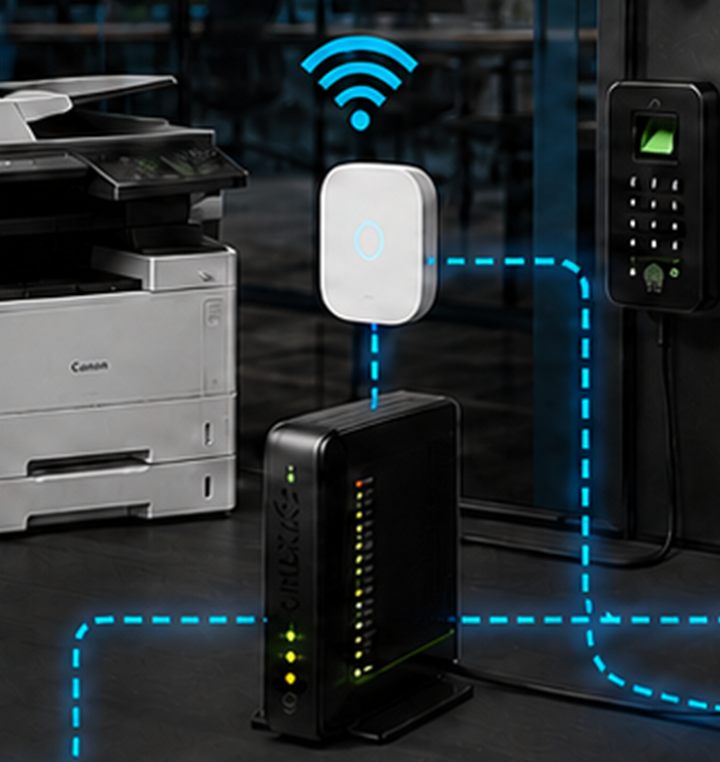
Wireless is not a compromise. Used properly it does two jobs: it connects premises where fibre has not been laid or would take months, and it provides the independent second path that makes a business resilient. Both use the same carrier-grade equipment, installed and aligned by our own technicians.
Where wireless earns its place
- Premises fibre has not reached, in town, on industrial parks and on farms.
- Sites that need to be working in days rather than months.
- A second, independent link so a single cable fault does not stop the business.
- Point-to-point links between buildings on the same property, carrying the same network across the gap.
- Temporary sites, depots and construction offices.
Point-to-point: the Riverside example
Riverside High School needed a camera covering a sports field about 200 metres from the nearest building. Most of the suppliers who quoted wanted to trench across the fields. We put the camera on a custom pole and bracket and linked it back over a point-to-point wireless connection carrying the same network, with no trenching and no disruption to the grounds.
What we install
A wireless service is only as good as the equipment on the roof and the design behind it. We survey the site, check line of sight, mount and align the radios, and configure the network behind them, including the separation between voice, office, staff and guest traffic where that matters.
Questions we are asked
Is wireless as fast as fibre?
Carrier-grade business wireless delivers speeds comparable to fibre for most business workloads. What differs is how it behaves in heavy rain and how it scales at very high volumes, which is why we survey the site rather than promise a figure up front.
How quickly can it be installed?
Usually within days, once we have confirmed line of sight, which is the main reason businesses choose it while waiting for fibre.
Can we have both wireless and fibre?
Yes, and for any business that cannot afford to be offline, that is the sensible arrangement: one as the main link, the other as automatic failover.