- Published
- August 2026
- Length
- 13 pages
- Written for
- Owners, office managers, finance managers and technology decision-makers.
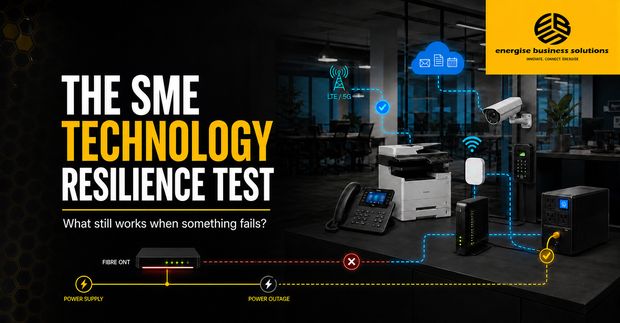
Most SME technology failures are not isolated. A fibre fault can affect calls, cloud applications, card payments, remote access, print and scan workflows and off-site monitoring at the same time. A later power failure can then disable the router, the ONT, switches, Wi-Fi, phones, cameras and access control that the backup plan assumed would still be running.
What the report covers
- Redundancy versus resilience
- Naming the functions that must continue
- Mapping the full dependency chain
- Independent, powered, monitored and tested fallbacks
- Using a downtime-cost range to set priorities
- The Four-Hour Business Survival Test
Key points
- Resilience is the tested ability to anticipate disruption, continue essential work at an acceptable level, recover cleanly and adapt afterwards.
- The weakest point is usually a shared dependency: one router, one switch, one power circuit, one mobile network, one SIM with an expired bundle, or one person who knows how the failover works.
- Name the business functions that must continue for four hours, even in degraded form, then map each to its chain of power, connectivity, network, cloud, device, supplier and people.
- A duplicated component is not the same as an independent, powered, monitored and tested fallback.
Read the full report
The complete report, with the checklists and the decision record, is free to download.